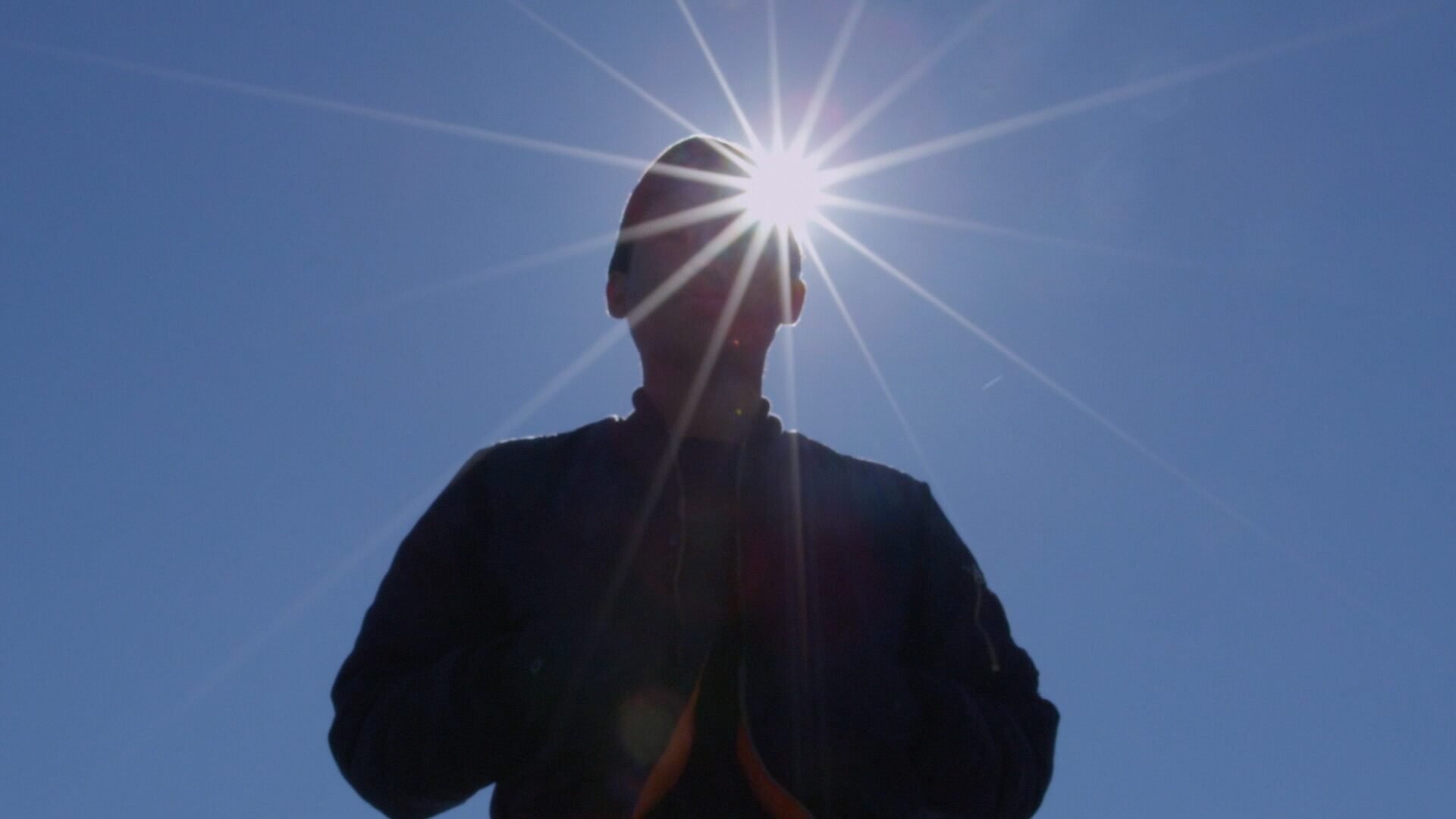
Klap: 88:88 (2015) Isiah Medina, Quantity Cinema
At last the money comes through and you can pay for electricity. The appliances come back to life, the screen flickers 88:88, —:—. The time of infinity and the no-thing of editing that gives it order. That no-thing gives us reason to think through film. That nothingness of editing, the empty in-between, is invariant like a mathematical operation. Minimal preparation: just show up on set, find the composition, and begin. Philosophy is easy, poverty is hard.
The screening of 88:88 ends, the tap of total flow is cut off, the colorful carousel of interlocked images and sounds — how do they all even fit in there! — and the cyclical structure reveals itself only as yet another horizon to be crossed. Viewers of Medina’s film wait for an explanation, perhaps they even expect mysticism. But standing before them is an aggressive, uncompromising director obsessed with set theory, Eisenstein’s experiments with silent film, animated philosophy (Badiou, Marx), and eventually, with equal seriousness, Star Wars and Kanye West. For some reason, it never turns into kitsch. First you quote others, then yourself, then gradually wiggle yourself free from other people’s grasp and no longer feel the need to prove anything to master figures.
Films usually begin with some thing — a premise, a subject, preconceived factuality — but many people have nothing and begin precisely from there: with the technique that connects those empty nothings, editing. When French critics argued against the “cinema of quality,” they meant films that begin with the screenplay, films dictated by language, not unlike today’s AI prompting. That is why Medina searches for other infinities: not films of non-quality, but Quantity Cinema, as he calls his production company. Within a close circle of friends, he continues to think through form and production conditions, invent systems, and the finished films left behind stand before them as a challenge: “don’t be cowards.” Record what is happening, invent around it a new no-thing that can hold what was observed and allows it to grow. Take it seriously.
“Do we have to try to capture reality without any interventions, or instead we should find a way to document the very form of intervention? Some believe we can see in cinema a sort of pre-linguistic vision without the names we give things, but insofar as the name names the gap that separates itself from itself, it will name the thing. We document the cut that names the fact there is no-thing to see.”
88:88 premiered ten years ago, and still nothing sounds or looks like Medina’s debut, a self-assured step in a completely new direction — a direction he is, moreover, able to articulate with playful ease.
Small hall
65 minutes
English with Czech subtitles
The Third Space program brings all areas of ARCHA+ to life, except for the Large Hall. The name itself is based on the sociological concept of third places, which describes spaces between home, school, or work where people meet and spend their free time. More information can be found here.